
 Français
 Italiano
 Español
 Deutsch
 Nederlands
 English

What is KAPLA?
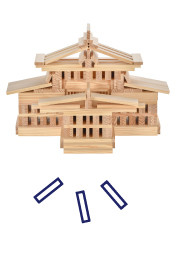
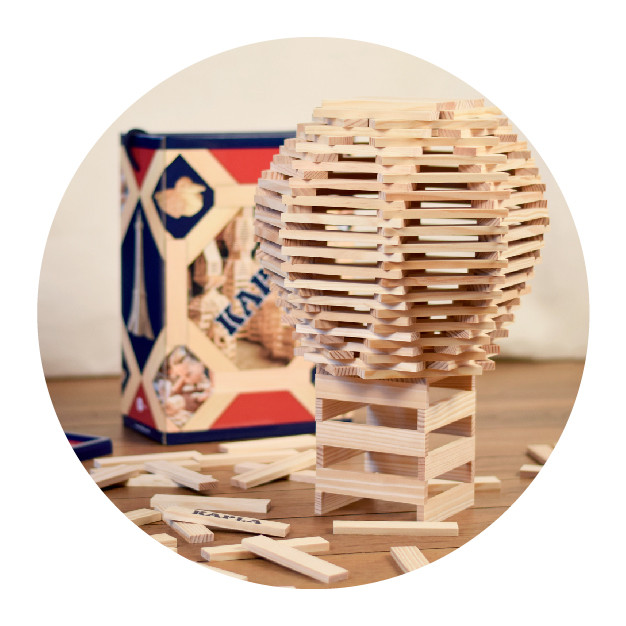
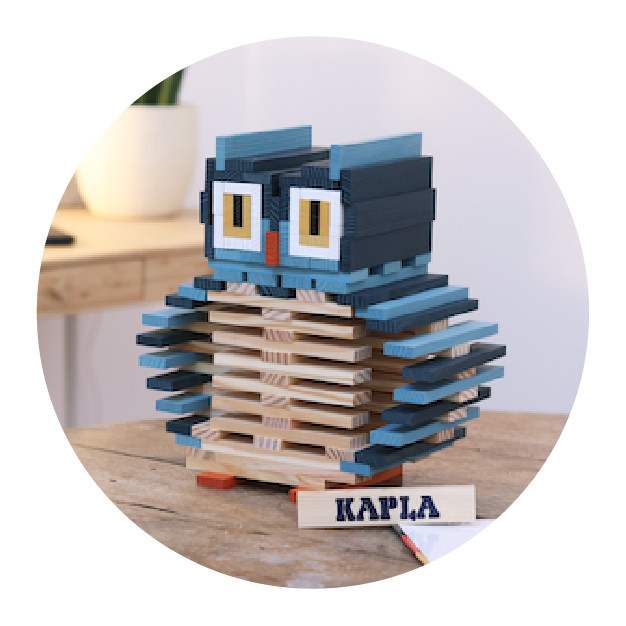
KAPLA is a wooden construction game made up of identical planks, allowing an infinite number of creations without glue, nails, or any kind of fasteners—only balance and gravity.
Who invented KAPLA?
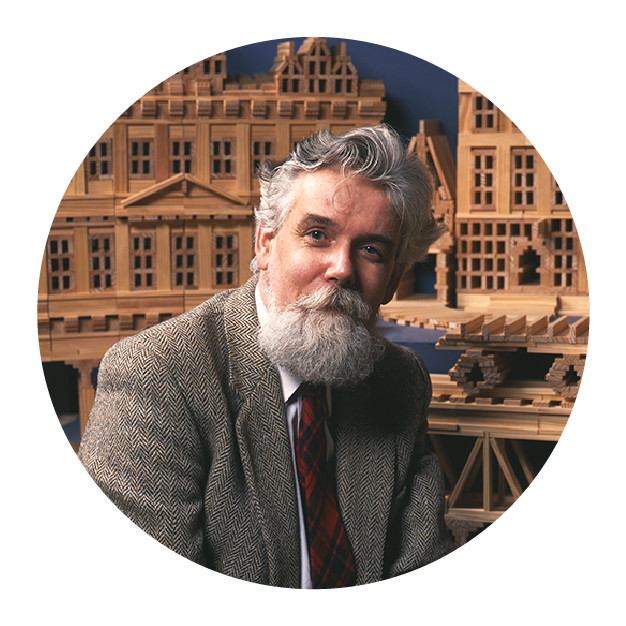
KAPLA was invented by Tom van der Bruggen, a Dutch creator, in the late 1980s. His initial goal was to design a simple system allowing free construction, even of monumental structures.
What does the word KAPLA mean?
KAPLA is a contraction of “Kabouter Plankjes,” which means “elf planks” in Dutch.
What wood are KAPLA planks made of?
KAPLA planks are made from Landes pine, a French wood known for its strength, lightness, and durability, perfectly suited to construction play.
Why are all KAPLA planks identical?
KAPLA planks follow a precise mathematical ratio (1:3:5:15), ensuring optimal stability. This uniformity allows for free and unconstrained building, encouraging creativity rather than assembly based on predetermined shapes.
From what age can you play with KAPLA?
KAPLA is accessible from age 3 and has no upper age limit. It is used by children, teenagers, adults, and seniors alike.
Is KAPLA an educational toy?
Yes. KAPLA is recognized as an educational toy that develops:
• concentration
• fine motor skills
• creativity
• cooperation
• intuitive understanding of physical laws (balance, gravity, symmetry)
Why is KAPLA used in schools?
KAPLA is widely used in schools because it promotes learning through hands-on activity, stimulates imagination, and encourages collective work—without screens or imposed rules.
Is KAPLA used by professionals?
Yes. KAPLA is used by:
• architects
• artists
• teachers
• care centers
• cultural mediators
It serves as a pedagogical tool, a creative support, and an artistic medium.
Can you build large constructions with KAPLA?
Yes. KAPLA makes it possible to build monumental structures, sometimes featured in the Guinness World Records, such as towers several dozen meters high or reproductions of historical monuments.
Where are KAPLA planks made?
KAPLA now has two production sites in Gironde and a production unit in Tangier, allowing the brand to meet demand while maintaining a high level of quality and control.
Is KAPLA a sustainable toy?
Yes. KAPLA is a durable and timeless toy, made of wood, designed to be passed down from generation to generation and used for many years without wearing out.
How is KAPLA different from other construction toys?
Unlike interlocking building sets or models with fixed designs, KAPLA offers no plans, no rules, and no predefined objective. It gives users complete freedom, regardless of their age or skill level.
Is KAPLA suitable for group use?
Yes. KAPLA is particularly suitable for group settings: classrooms, workshops, cultural centers, events. It encourages cooperation, exchange, and collaborative creation.
Is KAPLA compatible with Montessori education?
Yes. KAPLA is fully compatible with Montessori pedagogy. The game is based on free manipulation, experimentation, autonomy, and learning through trial and error, without imposed instructions.
Why does KAPLA align with Montessori principles?
KAPLA respects several core Montessori principles:
• freedom of action
• simple, uncluttered material
• natural self-correction through balance
• spontaneous concentration and repetition
• respect for the child’s individual pace
Is KAPLA suitable for kindergarten?
Yes. KAPLA is widely used in kindergarten to develop fine motor skills, coordination, language, cooperation, and creativity.
Is KAPLA used in elementary school?
Yes. In elementary school, KAPLA helps introduce concepts in mathematics, geometry, symmetry, stability, and group work in a concrete and playful way.
Does KAPLA fit within STEM approaches?
Yes. KAPLA fits perfectly within STEM approaches (Science, Technology, Engineering, Mathematics) by offering hands-on exploration of physical laws, engineering, and mathematics.
Which STEM concepts can be explored with KAPLA?
With KAPLA, it is possible to explore:
• balance and gravity
• forces and loads
• geometry and proportions
• symmetry and structures
• problem-solving
Is KAPLA suitable for learning mathematics?
Yes. KAPLA is a concrete support for learning mathematics, particularly concepts of proportion, repetition, symmetry, sequences, and volumes.
Does KAPLA encourage cooperation in the classroom?
Yes. KAPLA naturally encourages cooperation, communication, and collective building, without competition.
Can KAPLA be used for cross-disciplinary projects?
Yes. KAPLA is an excellent support for cross-disciplinary projects combining mathematics, visual arts, science, architecture history, or oral expression.de va-et-vient
Is KAPLA suitable for children with special educational needs?
Yes. KAPLA is suitable for children with special educational needs thanks to its accessibility, modularity, and lack of restrictive rules.
Is KAPLA suitable for older adults?
Yes. KAPLA is perfectly suited to seniors, regardless of their mobility or autonomy level. The simple handling of planks helps stimulate cognitive and manual activity without technical constraints.
What are the benefits of KAPLA for seniors?
For seniors, KAPLA helps:
• stimulate memory and attention
• maintain fine motor skills
• encourage hand-eye coordination
• foster creativity and self-esteem
• create social connection through group activities
Is KAPLA used in nursing homes or senior residences?
Yes. KAPLA is used in nursing homes, senior residences, and medico-social facilities as part of playful, creative, or intergenerational workshops.
Why is KAPLA relevant for healthcare professionals?
KAPLA is appreciated by healthcare professionals because it offers:
• a non-infantilizing approach
• adaptation to each person’s abilities
• immediate engagement in an activity
• detailed observation of motor and cognitive abilities
Is KAPLA used by occupational therapists?
Yes. Occupational therapists use KAPLA for fin e motor exercises, coordination, and planning, individually or in groups.
Is KAPLA used by psychomotor therapists?
Yes. Psychomotor therapists use KAPLA to work on spatial structuring, balance, coordination, and body awareness through manipulation and construction.
Is KAPLA used in rehabilitation contexts?
KAPLA can be incorporated into functional rehabilitation workshops, notably for hands, coordination, and concentration, with adjustable duration and construction complexity.
Is KAPLA suitable for intergenerational workshops?
Yes. KAPLA is especially suitable for intergenerational workshops, bringing together children, adults, and seniors around a common activity, with no hierarchy of skill levels.
Is KAPLA a fail-safe tool?
Yes. KAPLA is a fail-safe tool: there is no right or wrong answer, no objective to achieve. This is essential in care and support contexts.